June 3, 2026
The See Saw Effect
How an episode of Bluey triggered a vivid, 30-year-old memory of a high-stakes playground accident, sparking a reflection on the architecture of associative memory over forced corporate lessons.
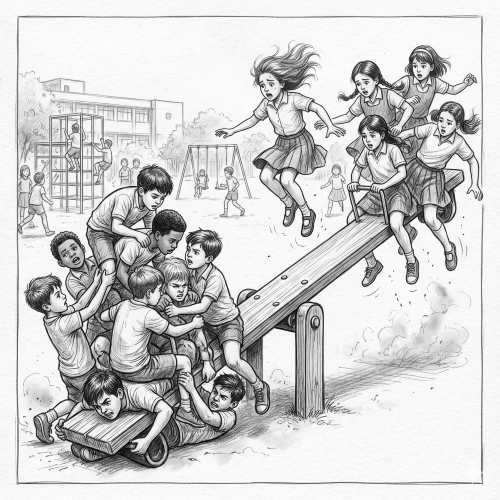
The brain is a fascinating organ. One moment you're watching a kids' cartoon and the next moment you're transported to your childhood, decades ago.
This happened a couple of days ago. The kiddo was watching a Bluey episode about a see-saw. I only caught the last few scenes. The life lesson was supposedly about teamwork — all the kids, when working together, could lift the dad carrying two rocks, too heavy for any individual child. In the end, the kids jump off, causing Bandit, the dad, to slam on the ground!
That's when it happened. From the depths of my mind, my brain fetched a memory that took me to the school recess of New Yashoda Public School, Hisar, mid-90s, almost 30 years ago. I was probably in 5th or 6th grade at the time.
The class decided to have a match. Girls vs Boys, to see who can lift the other side on the playground see-saw. The girls, as many as could, piled on one side of the see-saw. The boys started piling on the other side. One of the boys got so engrossed in the goal that he got under the see-saw and gave it his all, pulling down with all his might.
Eventually, the girls' side budged, and they started rising. And as they started losing, they all abandoned post. You don't need to be a physics major to guess what happened next. Unlike cartoons, laws of gravity don't wait for you to get to a safe place before activating. The entire boys' side slammed down on the guy who was under the see-saw, hitting him in the face, probably before he could even register that the resistance from the other side was gone.
By sheer luck, or divine intervention, take your pick, the metal just missed his eye, so thankfully, there wasn't any serious damage done. His eyebrow did split open, requiring multiple stitches to put it back together. I switched schools the next grade for unrelated reasons, but I ran into the ex-classmate years later in a coaching class during high school. He still carried the scar, and the memories of the incident.
You can extrapolate all sorts of LinkedIn-friendly leadership and workplace lessons here. Don't abandon your team at the first sign of trouble. A leader must prevent the first exit to avoid an exodus. Give your project your all, but ensure your physical and psychological safety.
But most importantly, this was a very insightful peek into the workings of associative memory. Given the right environmental retrieval cues, you never know what will come out of the well of your long-term memories.
PS: As always, this started as a handwritten note which was later transcribed with Claude and edited with inputs from Claude and Gemini. Image generated by Gemini.