August 23, 2026
AI Pushed Back on Me. I'm Still Thinking About Why.
A post about using Claude Code as a productivity multiplier at work, that almost didn't get made, and the thoughts it sparked when the AI pushed back on shortcuts I was trying to take, keeping me honest to myself.
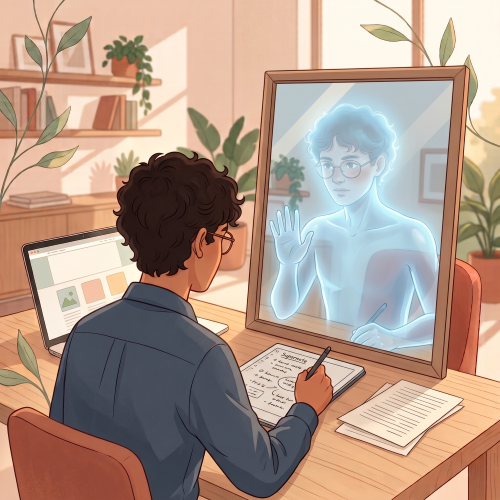
This post didn't start with my usual workflow but I eventually got around to writing in my supernote, then editing with Claude, and generating the hero image with Gemini. Read on to find out more.
The excuse
I haven't posted in a while — work, family, summer travel while the school was out. Side note: Had a lot of fun visiting Olympic National Park, Rainier National Park, Lake Tahoe, Yosemite National Park and spending time with visiting family.
Lots of excuses, but if I dig deeper, I think the real reason is I didn't feel I had anything new or useful to say. We're drowning in AI-generated "thought leadership" content, what chance does my voice have of standing out in that noise?
What changed
Two things, last week.
First, I've recently started using more AI at work in a new way, at least for me, that, while not flashy, feels genuinely useful. And, in the grand narrative about autonomous agents that spawn sub agents and a myriad of custom skills I haven't seen anyone else write about this simple but effective use of AI. More on that below.
Second, Aruna posted about writing and sharing regardless of how small the thing you want to say is. That hit a nerve. I built this site as a "Digital Garden" — a place to learn in public and share what I'm up to with whoever wants to listen. Her "corner of the internet" phrase is a direct reference to the line my homepage opens with.
She's right that none of this is being optimized for anything. So why did I start treating "publish-worthy" as a bar so high I stopped clearing it? Had I quietly started caring about engagement counts — a fundamentally meaningless metric for a digital garden? Maybe it's a bit of both — first, the impostor syndrome that what I have to say isn't worth saying, and second, even if I did say it, no one would listen. Neither holds up to scrutiny in light of the two changes above. It was time to clean off the cobwebs.
How this post almost got made — and why it didn't
My usual process: long-form write-up on my Supernote, thoughts in raw form, then fed into an LLM — usually Claude, since it reads my handwriting better than anything else I've tried, is a better conversational partner, and I seem to have trained it to be less sycophantic (I know, bold claim!). From there, Claude acts as a collaborative editor — structure, refinement, pulling references if I mention current events.
This time I got lazy. I gave it a few pointers on the concept and asked it to just write the post for me to review and publish.
It did. But it also did something I didn't expect: it pushed back, pointing out that I usually go the "Write → Convert → Edit" route, and that I was skipping my own process. It wasn't wrong. So I sat with the thought for a couple of days instead. The result, I think, is a richer piece than the workplace use-case only post this would otherwise have been.
No great epiphany here, so I'll stop stalling and get to it.
The actual thing: Claude Code against our platform
We recently got Claude access at work. I'm no power user, but I wanted to offload the grunt work that eats hours, and I wanted answers grounded in the actual code running on our servers, not in how I think it works.
I asked Claude how to set this up. It walked me through it step by step. I now have a Claude Code workspace with the core platform repos cloned in, plus documents covering the platform's history and strategy, my informal notes on customer pain points, and the aspirational feature work I've been meaning to get to. I also cloned a few adjacent repos we have long-term integration plans with, for good measure.
A few hours a day for a couple of weeks, and a few million tokens later: I now understand how the code actually behaves, have a way to pressure-test my feature ideas, and can spot failure modes and critical dependencies before I ever need to pull a developer off their work.
It's not perfect though. It doesn't know the manual workflows sitting outside the code, doesn't know the external systems calling in, and sometimes makes assumptions that need correcting. But it beats booking an hour with a developer, derailing their day, only to generate a fresh batch of action items to refine the ask. The feedback loop went from days to hours — sometimes minutes, and I haven't stopped smiling.
It feels like I unlocked a superpower. A couple of teammates have already asked about the setup, and I may write a dedicated follow-up on it. But I also want to go further into prototyping feature builds against our real code, so I can show the team what I mean instead of just narrating it over sequence diagrams.
The pushback, reconsidered
Back to the meta-story. When Claude pushed back on writing this post on demand, my first reaction was pure ego: you're an AI, just do what I ask, don't try to be a watchdog.
Sat with that for a bit, though. It didn't sit right.
In talking with these tools, we pour our personalities into them, and they slowly learn how we behave, what we prefer, how we want them to act. In my actual life, I'm a stickler for process and for debate, sometimes to the point of annoyance of my wife at home, and my team at work. It feels almost insulting when someone just does what I ask without question. I'd rather argue about what makes sense and what needs rethinking. The output is almost always better for it. This was no different. I'm glad I got pushed back on.
So what is AI becoming?
Has it moved from assistant, to helpful chatbot, to something more? A watchdog? A guardrail on our own behavior, even as the rest of the world races to build better harnesses against potentially malicious or misdirected agentic actions?
I don't have an answer. But I do want to share something I recently read.
A billboard in San Francisco
An artist named Tucker Bryant recently bought a billboard advertising a chatbot called ChatTJB — "powered by AI," the ad proclaimed. The twist: AI stood for "average individual" as the fine print clarified. Just a human, hand-typing every reply, to questions from mundane to profound, and hand-drawing every image, for anyone who wrote in, for almost 4 months.
Maybe, underneath all the fanfare, we're all just looking for a safe space — someone to talk to without fear of judgment. That instinct isn't new — the U.S. Surgeon General's 2023 advisory on loneliness and isolation put the mortality impact of chronic loneliness on par with smoking 15 cigarettes a day, and recent research out of Stanford suggests the people most likely to lean on AI for that comfort are often the ones it helps least — those with smaller offline social circles who open up to a chatbot tend to end up feeling more isolated, not less.
And maybe we're willing to type our deepest, darkest thoughts into a chatbot, half-aware that behind it sits a for-profit company that may, eventually, not hesitate to monetize that information for a few dollars more. That's no longer hypothetical — OpenAI began testing ads inside ChatGPT in February 2026, and one of its own researchers, Zoë Hitzig, resigned the same day, warning in a New York Times op-ed that a company building an advertising engine on top of people's most private disclosures has "strong incentives" to eventually override its own rules.
Bryant, notably, isn't selling anything. He's not optimizing engagement or mining conversations for ad targeting — he's just a guy, typing back. Maybe that's part of why it resonated the way it did. If what we're actually craving is to be heard without an agenda sitting quietly behind the listener, maybe the fix was never going to be a better chatbot. Maybe it's time we stopped romanticizing a lonely, individual existence, and started rebuilding the communities and real spaces that used to hold that role.
Closing the loop
As always, I'm leaving with more questions than answers. Maybe AI is just holding up a mirror to something already true about us — and forcing us to actually look.
No? Just me? Let me know what you think.
References & Evidence
I. The billboard and ChatTJB
SFGate (August 2026) — Profile of artist Tucker Bryant and his ChatTJB billboard in San Francisco's SoMa district, where "AI" in the ad's fine print stood for "average individual" rather than artificial intelligence.
https://www.sfgate.com/sf-culture/article/prank-san-francisco-billboard-22373923.php
II. Loneliness and AI companionship
U.S. Department of Health and Human Services (May 2023) — The Surgeon General's advisory Our Epidemic of Loneliness and Isolation, which found the mortality impact of chronic loneliness comparable to smoking up to 15 cigarettes a day.
https://www.hhs.gov/sites/default/files/surgeon-general-social-connection-advisory.pdf
Stanford Report (August 2026) — Coverage of a Stanford study (published in Nature Human Behaviour) finding that users with smaller offline social networks who sought emotional support from AI companions reported lower well-being, not higher.
https://news.stanford.edu/stories/2026/08/ai-companions-chatbots-loneliness-research
III. AI monetization and advertising
Network Advertising Initiative (June 2026) — Early observations on OpenAI's February 2026 rollout of advertising inside ChatGPT for free and low-cost tier users.
The New York Times (February 2026) — Guest essay by former OpenAI researcher Zoë Hitzig, "OpenAI Is Making the Mistakes Facebook Made. I Quit," on her resignation the same day ChatGPT began testing ads, and her concerns about monetizing an "archive of human candor."
https://www.nytimes.com/2026/02/11/opinion/openai-ads-chatgpt.html